


Climate experts say it is too early to determine whether Malawi will face a strong El Niño event until updated annual forecasts are issued, as global models are pointing to a strong event.
This comes as the World Meteorological Organization (WMO) said a strong El Niño event may develop from mid-2026, with potential effects on global temperatures and rainfall patterns.
Lecturer in Climate Sciences at Malawi University of Science and Technology (MUST), Malazi Mkandawire, said the accuracy remains uncertain, stressing that there should be a wait for the forecast that will be released in July and August.
Principal Meteorologist responsible for Public Weather Services in the Department of Climate Change and Meteorological Services, James Pagona, said there is no need for panic.
He said the reports about the phenomenon are just preliminary projections as the department has not yet released its official seasonal forecast for Malawi.

“Malawians should be cautious with this information. It is too early to start making decisions until the official seasonal forecast. A signal of the El Niño–Southern Oscillation (ENSO) system in Malawi will be clear in August,” Pagona said.
Mkandawire added that if the strong El Niño does indeed occur, dry spells are expected both in the southern half and along the Lakeshore areas, and when rain comes, it is usually intense, leading to strong winds and floods.

“Climate-wise, Malawi is divided into two regions: the northern half and the southern half. El Niño, whether weak, moderate, or strong these two general effects: Normal (average) rainfall or above normal (above average) rainfall in the Northern half and below normal (more dry spells) in the southern half,” he said.
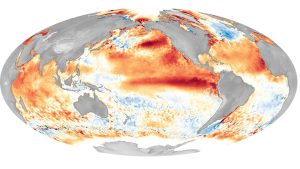
The latest monthly Global Seasonal Climate Update from the WMO signals a clear shift in the Equatorial Pacific, with sea-surface temperatures rising and pointing to a likely return of El Niño conditions as early as May to July 2026.
Chief of Climate Prediction at the WMO, Wilfran Moufouma Okia, said climate models indicate that this may be a strong event, although the so-called spring predictability barrier remains a challenge for certainty at this time of year.
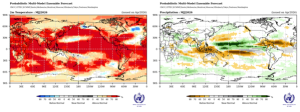
“After a period of neutral conditions at the start of the year, climate models are now strongly aligned, and there is high confidence in the onset of El Niño, followed by further intensification in the months that follow,” Okia said.
Meanwhile, the United Nations Office for the Coordination of Humanitarian Affairs (OCHA) says it is preparing to protect people who could be exposed to a possibly strong El Niño, expected to develop in the coming weeks and last into 2027.
Chairperson of the inter-agency global ENSO Analysis Cell at OCHA, John Long, said that despite the uncertainty, preparations cannot wait.
“El Niño is a complex phenomenon, and it is becoming even harder to predict its impacts with the added turbulence of climate change,” Long said.
El Niño is the warm phase of the El Niño–Southern Oscillation (ENSO), a recurring climate cycle linked to changes in Pacific Ocean temperatures that can influence rainfall and temperatures globally.
The last El Niño to affect Malawi occurred during the 2023/2024 agricultural season, beginning in late 2023 and extending into early 2024.
The event was characterised by delayed rains, inadequate cumulative rainfall and prolonged dry spells in several parts of the country.
