


Saulos Mtintha never imagined that one day he would become self-reliant. Growing up in a household surviving on a shoestring budget, with parents who rely solely on rain-fed subsistence farming, he was forced to drop out of secondary school.
“They have barely enough to fend for us the whole year,” he said. “I am the second born out of four. My elder brother also dropped out of school while in Standard 8 because my parents could not afford to provide his educational needs.”
With no prospects and spending his days aimlessly in the village, Mtintha’s life took a new turn when he was called to attend a meeting at the group village head Mphedza’s Headquarters. There, he learned that he was among a few young men from underprivileged families selected to benefit from the vocational skills education support programme by SOS Children’s Villages Malawi in Ngabu.
“I could not believe my ears, considering that I had no formal education to qualify for that,” said Saulos.
After all the processes were completed, Mtintha was sent to Lilongwe Technical College. He enrolled for welding and fabrication, a course that took him six months to finish.
After returning home, he opened a welding shop in his village and even employed two other boys from the community. He now has plans to expand his business to serve as many customers as possible.
Mtintha is among 1,377 vulnerable young people empowered by the SOS Children’s Villages Ngabu Programme through inclusive vocational skills training under the four-year Family Strengthening Project in the villages of Mphungu and Mphedza in Ngabu, Chikwawa. The goal of the project is to ensure that children and young people deprived of parental care have an equal chance to succeed in life.
‘Creating wealth for themselves’
SOS Children’s Villages Ngabu Programme Director Michael Nyoni said the programme has also empowered 207 vulnerable households to become self-reliant through farming and other income-generating activities.
Nyoni further stated that for a long time, the country’s development efforts have focused on poverty reduction, a development that saddles it with the yoke of dependency, while, despite all the efforts in that regard, the level of poverty in Malawi remains high.
“Our project goal shifts the trajectory from dependence to the concept of wealth creation and self-reliance. This perspective promotes ways of enabling the poor to create wealth for themselves as a conduit of ending poverty,” he said.
Nyoni’s sentiments are in line with the Malawi 2063, which aims to transform the country into a wealthy and self-reliant industrialised upper-middle-income country by the year 2063.
Felix Mpasanjesi, 45, a father of seven, is another beneficiary of the programme. He is already carving his path to success through irrigation farming.
Mpasanjesi recalls that at the peak of summer, in October 2023, he lost the vegetables to a dry spell that hit Ngabu, and he was helpless.
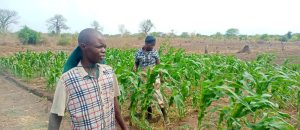
“I had several customers who came as far as Blantyre and booked my tomatoes, cabbage, and beetroot in advance but all wilted because I had no manpower to get water from as far as 100 meters from my garden,” explained Mpasanjesi.
However, his breakthrough came when, in 2024, officials from the programme intervened after hearing of his challenges.
“I ventured into serious vegetable farming in 2023 after I noticed a supply gap. The demand for vegetables was huge here, but the problem was how to sustain the farming, particularly during summer, a period during which our major rivers dry up and water is found far away from the gardens,” he said.
The Family Strengthen Project identified Mpasanjesi as one of the small-scale farmers to benefit from the water pump distribution drive. Currently, he is supplying vegetables to various markets around Ngabu and beyond.
People from Nyasa, Babiton, Singano, Dzongwe, and Mateyu come early in the morning to order eggplants, onions, and other vegetables, he said.
On a good market day, he makes K150,000 to K200,000.
“Everything has changed now. I can fend for my family and buy some luxuries of my choice. I bought a motorcycle and my family is better off than before,” Mpasanjesi said.
Recovery after Cyclone Freddy
For a 53-year-old single mother of seven, Elufe Mukota, Cyclone Freddy left a deep scar after sweeping away her entire house.
“It happened swiftly, like I was dreaming”. She recalled.
The trail of destruction left her big family destitute as her house was swept away, she had nothing left to her name.

“It was around midnight when I heard a ginormous sound. In no time, the house was engulfed in water, but luckily, none of my children were hurt. My elder sister took me and my children to stay in her house, which was also not big enough to accommodate all of us. We lived a hopeless life,” she said.
Her situation improved when SOS Children’s Villages Malawi stepped in with support. Mukota is among eight households that have benefited from disaster-resilient houses constructed through the programme in Ngabu.
She was provided with livestock and reintegrated into the Mpheza Village Savings and Loans group.
She said she was trained and had access to a small loan and opened a small business.
For Nyoni, the programme mirrors the United Nations’ Sustainable Development Goal number 1, which aims to eradicate poverty in all its forms everywhere by 2030.
