


This week, Malawians have seen banks announcing upward revision of unsecured loans – these are loans that do not require collateral. For example, National Bank of Malawi has announced that under premium platinum, one can borrow up to K100, 000, 000 and up to K50, 000, 000 for premium gold, with K20, 000, 000 dangled for civil servant loans.
While the interest rates of the loans remain the privilege of the banks per customer basis, such announcements signal that the banks have liquid cash which they want to offload to maintain their core business of lending.
The liquidity in banks has not come as a mere coincidence, the government, especially the Ministry of Finance under line minister Joseph Mwanamvekha, has pushed for that in a liberal manner.
On 27, 29 January and 3 February 2026, the public was surprised when the government refused to borrow billions of money that financial service providers, including and especially banks, were offering through treasury bills.
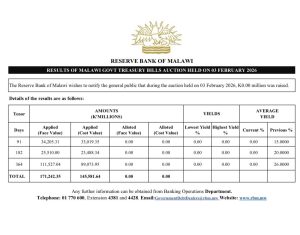
The government did not just stop there, on February 10, 2026, the financial sector offered the government K179 billion, it only borrowed K12 billion. On 13th the same month, the financial sector offered the government K94 billion, but it only borrowed K22 billion.
The trend has been the same where the government has refused to borrow about 90 percent of the money the financial sector has offered, leaving the banks with a lot of liquidity that they still need to lend out without which their business is in jeopardy.
For a long time, the private sector has been crowded out because of government borrowing and if banks happen to lend to the private sector, they do so at very exorbitant rates.
This slows down national development as for every economy to grow with one inch, the private sector needs to grow with two inches and provide that spillover effect to the economy.
A former banker Benedicto Nkhoma therefore believes Mwanamvekha’s lack of appetite for borrowing has pushed the banks to scout other means of shredding off the excess liquidity which the government has pushed away.
He says normally they would park that money in treasury bills where it is safe with predictable returns but the government has refused to borrow from them.
“Now yields are lower, volumes are limited, returns have dropped, so what must banks do and where are they going? Retail loans, salary packed loans, unsecured personal loans,” he adds.
It is therefore clear that Mwanamvekha’s resolve not to borrow has helped to push the banks to offload the money towards the private sector, which in turn will develop the economy further.
Delivering the midyear national budget statement at Parliament in November last year, Mwanamvekha vowed to realign the economy by, among others, making sure that the private sector is able to access affordable loans.
Less than three months after the promise, the results are now being seen on the ground.
Once the private sector is able to access more and affordable financing, it will be able to upscale, start new ventures, create employment opportunities, export more, and pay more taxes for national development among many other benefits.
