


On the left, Martha Nthengu, a self-proclaimed faith healer, kept Agnes for three months at her backstreet church to “redeem” her from evil spirits.
By Catherine Alumando, Mwanza
As Shadreck Jumbe paced around a church compound only commonly referred to as “kumapemphero” by the locals in Masokosa village in Mwanza, the cries of his wife, Agnes, pierced through the walls.
He had come searching for her, knowing she was somewhere inside the church where she had been kept against his will from November 2025 to January this year, allegedly for prayers intended to cure her mental illness.
For Jumbe, walking away from the prayer shrine was a hard pill to swallow. He said he felt helpless, fully aware that there was nothing he could do to rescue her from the pain she was enduring at the hands of a faith healer, Martha Nthengu, who claimed she was performing a deliverance session to “redeem her” from her condition.
Despite repeated attempts, Jumbe said he was consistently denied access to his wife.
“No matter how hard I tried, they could not allow me to see her,” he said with a trembling voice. “I was only allowed to send food and other items through her sister, who was posing as her guardian there.”
As weeks turned into months, Jumbe grew increasingly worried about Agnes’s condition and safety. After several failed attempts to see his wife, Jumbe reported the matter to Mwanza Police, prompting immediate intervention. She was eventually rescued from the unregistered, self-proclaimed prayer shrine.
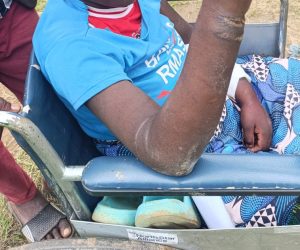
Jumbe has been married to his wife for five years. From the very beginning, he knew she had a mental illness. From the little money he had, he made sure she was taken to Mwanza District Hospital and Zomba Mental Hospital from time to time for treatment.
Being familiar with his wife’s symptoms, he could usually tell when an episode was about to happen and knew how best to help her.
According to Jumbe, the medical treatment had been helping his wife manage her condition until one Monday afternoon, when things took a sudden turn. “I was coming from doing piecework, that’s when I saw my wife on a motorbike,” he recalled.
Concerned, he stopped the motorbike and decided to take Agnes to the hospital immediately. He pulled K5,000 from his pocket to pay the rider so he could take her for medical attention.
“As I was about to pay him, Agnes snatched the money from my hands and ran away,” he narrated.
“I stayed behind to settle the bill with the kabaza man before following her. Little did I know that was a mistake.”
Jumbe explained that because it was market day in the district, the area was crowded and chaotic. Despite all efforts, he could not trace his wife.
After several days of searching, he went to Agnes’s parents’ home, where he was told that they had sent her to the faith healer.

A community problem
Jumbe’s experience reveals a hidden practice within the community. MBC has established that such practice was not entirely unknown within the community, but efforts to stop them proved unsuccessful.
A resident of Masokosa Village, who opted for anonymity, disclosed that a structure had been deliberately built within the shrine premises to accommodate people suffering from various illnesses.
“Everything was done in secret so that health authorities would not find out,” said the source.
Group Village Headman Masokosa admitted that he was aware of the prayer shrine and the activities taking place there, but said his attempts to stop the prophetess were ignored.
“Even people from Mozambique were coming there for prayers to be healed,” said the Group Village Headman. “I summoned her several times and advised her to stop keeping patients at her place, but all efforts were futile.”
He added that he encouraged her to follow acceptable religious practices.
“I advised her that instead of keeping patients, she could be visiting them in hospitals for prayers, just like other pastors do,” he said. “But she refused to listen.”
When the police received a report from Jumbe last Thursday, a team of police officers went to the scene and arrested Nthengu and two others for allegedly intending to cause grievous harm, contrary to section 315 of the Penal Code.
The suspect’s method entailed flogging and chaining the patients, said Deputy Public Relations Officer for Mwanza Police, Rita Nyirongo.
“We found the victim tied with ropes and bearing wounds on both her hands and legs,” said Nyirongo. “They believed she was possessed by evil spirits.”
Chairperson for the Pastors’ Fraternal in Mwanza District, Anord Phiri, said the word of God does not give religious leaders authority to detain sick people in the name of healing.
“Our responsibility is to offer spiritual support through prayer,” Phiri said. “Medical doctors, who are trained and mandated, should be allowed to do their work so that sick members receive proper health care.”
Mischek Naliya, a Mental Health Clinical Officer at Mwanza District Hospital, said Agnes’s case reflects a worrying rise in mental health conditions in the district.
“Since 2022, we have recorded about 450 mental health cases here in Mwanza,” said Naliya.
On Agnes’s current condition, Naliya said she was initially admitted to Mwanza District Hospital but later referred to Zomba Mental Hospital for intensive treatment.
“Our facility does not have the capacity to fully manage such advanced cases, hence the referral.”
Taking his turn, a mental health expert, Professor Chiwoza Bandawe, said it is important for people living with mental illness to get early medical treatment, warning that delays can lead to worsening conditions and life-threatening consequences.
He noted a surge in mental illness cases in Malawi, attributing the trend to factors such as drug and substance abuse, as well as hereditary conditions.
According to Bandawe, while prayer can play a supportive role, it cannot replace professional medical care.
“Even when prayers are needed, prayers alone cannot heal a patient,” he said. “A person needs medicines or other appropriate treatment for recovery.”
A practice such as this one has also raised human rights concerns. Boxten Kudziwe from the Centre for Human Rights Education, Advice and Assistance in Mwanza, said the case shows how urgent communities need to be reached out to with awareness and justice.
“There’s a need for communities to understand the dangers of violating people’s rights in the name of religion,” said Kudziwe.
A heavy load
Nthengu and her two accomplices are yet to appear in court while Jumbe’s wife is still undergoing treatment at Zomba Mental Hospital. However, it is not just Agnes carrying the burden of the disease. The stress it puts on caregivers is also a concern.
Jumbe is taking care of his wife by himself, without any support from her family as they are allegedly angry with him for removing her from the shrine.
“They told me that I should not involve them in anything concerning Agnes,” said Jumbe. “Sometimes it crosses my mind that I should just abandon her and run, but I can’t.”


