


Government says it remains determined to support initiatives that advance applied research, innovation and skills development within the country’s higher education institutions.
Minister of Education Science and Technology, Bright Msaka, disclosed this in Blantyre during the commissioning of the Malawi University of Business and Applied Sciences (MUBAS) Agriculture Mechanisation Unit, which is responsible for the manufacturing of agricultural equipment such as handheld tractors.
Msaka said the commissioning of the unit symbolizes a deliberate step toward transforming ideas into practical solutions, converting knowledge into productivity and ensuring that higher education contributes directly to national development.
The minister added that the Agriculture Mechanization Unit stands as a compelling demonstration of how education, science and technology can be effectively aligned with the aspirations of Malawi 2063.
“My Ministry will continue to work in partnership with universities, industry, and cooperating partners to ensure that innovation contributes meaningfully to the achievement of our national development objectives,” he said.
MUBAS Council Chairperson William Mpinganjira, described the agriculture mechanization unit as an epitome of the MUBAS endeavor to innovate, create and generate for national development.
Mpinganjira said that through the initiative, the institution has significantly reinforced its zeal to deliver practical solutions on the ground away from theoretical teaching in the classroom.
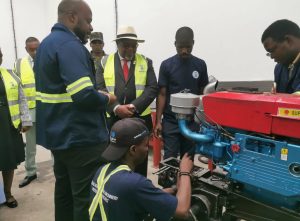
He said the unit not only provides students with hands-on training and exposure through their involvement in designing and manufacturing the equipment but also will enable MUBAS to be self-reliant through the selling of the products.
“By opening the unit, MUBAS has embraced this call to be a university that goes beyond theory to deliver practical solutions. This unit signifies a milestone and collective efforts to ensure that higher education can contribute to national development,” he said.
Additionally, he said the unit produces graduates who are not only employable but capable of opening businesses and becoming entrepreneurs, noting that Malawi can be industrialized by leveraging local knowledge.
MUBAS Vice Chancellor, Nancy Chitera, said the commissioning of the unit is a testament to how the university is actively responding to the national agenda by developing locally appropriate technologies—handheld tractors, maize shellers, planters and harvesters, with more innovations underway.
Chitera stated that these efforts demonstrate the critical role of higher education institutions in driving innovation, strengthening agricultural value chains, and advancing Malawi’s journey toward sustainable economic growth.
“MUBAS is quite aware that agriculture remains the backbone of Malawi’s economy. Yet its full potential continues to be constrained by limited mechanization and an over-reliance on manual labour. We are aware that Enabler 1 of the MW2063 agenda places strong emphasis on agricultural productivity and commercialization, calling for modern, technology-driven approaches to transform the sector hence developing this unit to complement just that,” said Chitera.
The construction of the Unit has received a financial boost and technical support from Germany and the United Nations Development Program (UNDP).
The total cost of the investment is around K5 billion, which includes purchase of the equipment, rehabilitation of the facility as well as training of staff members.
The unit has the capacity to produce three handheld tractors weekly which include designing and manufacturing of spare parts.
